

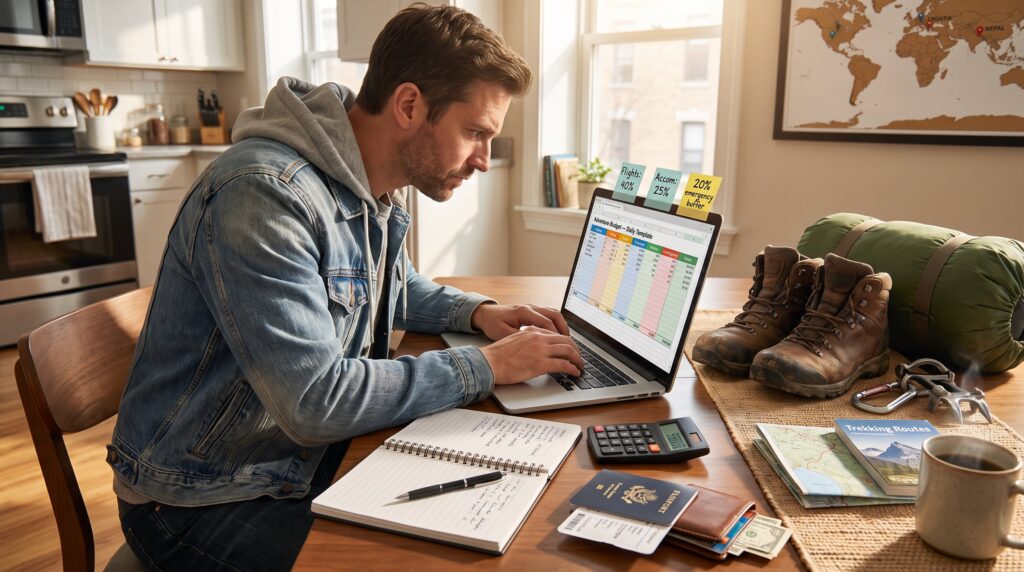
How to build a realistic budget for an adventure holiday starts with a clear trip definition: destination, length, season, and travel style. That clarity turns vague hopes into numbers and prevents last-minute shocks. This article guides planners through a simple daily budget template, precise cost ranges for major categories, and tested ways to cut expenses without compromising safety. Readers will leave with concrete line items to plug into a spreadsheet or app and a checklist for unavoidable pre-departure costs.
Key Takeaways
- Building a realistic budget for an adventure holiday starts with clearly defining the destination, trip length, season, and travel style to create an accurate daily budget template.
- Estimate major costs by breaking down categories into flights, accommodation, activities, gear, and insurance, using regional price ranges and adding a 20% contingency buffer to avoid overspending.
- Transportation, including international flights and local travel, typically consumes 20–35% of the adventure holiday budget, so compare private and local options to find cost savings.
- Plan activity and permit fees carefully by obtaining multiple quotes and verifying official permit sources to prevent surprise expenses on guides, porters, and rentals.
- Save money without compromising safety by traveling in shoulder seasons, choosing basic lodging and local meals, sharing transport, and renting specialized gear while always maintaining insurance coverage.
- Use a detailed spreadsheet with a daily budget template plus one-time pre-departure costs to turn budgeting uncertainty into a manageable plan for a safe and enjoyable adventure holiday.
Define Your Adventure, Duration, Travel Style And Create A Daily Budget Template
Decide the trip’s core facts first. Pick the destination, exact dates, and travel style, budget, mid‑range, or fully guided, and then build a per‑day template that adds up to the trip total.
Start with the fact: a 14‑day trek in Nepal will cost very differently than two weeks of coastal kayaking in Croatia. After destination and season are fixed, create four daily line items: lodging, food, local transport, and one main activity. Add a daily contingency amount for small emergencies or unexpected transport changes.
Example daily template (mid‑range):
- Lodging: $30–60
- Food: $15–35
- Local transport: $5–15
- Key activity: $20–80
- Daily contingency: $5–15
Turn that daily template into the trip total by multiplying by days, then add one‑time costs: international flights, visas, permits, guide deposits, and insurance. Common allocation ranges help planners check their math: flights 20–35% of total, accommodation 20–35%, activities 10–25%, local transport 5–10%, and a contingency/insurance slice of at least 2–5% plus a 20% emergency buffer. Planners who want step‑by‑step examples and destination resources can reference a practical travel planning guide for fuller trip templates and regional notes.
Practical tip: build the daily template in a spreadsheet and freeze the daily activity line, this prevents one splurge activity from blowing the whole plan.
Break Down Major Cost Categories: Transportation, Accommodation, Activities, Gear, Insurance
Allocate the budget into clear categories before researching prices. This section describes the categories and gives methodical ways to estimate costs.
Begin with the fact: most trip overspend comes from poorly estimated transport and activities. Planners should separate international travel (flights) from local transport (buses, shared jeeps, taxis). Accommodation gets its own line. Activities, permits, guide fees, and technical rentals form the next chunk. Finally, list gear purchases/rentals and insurance/medical costs.
Use current regional price bands to estimate. For example, many adventure regions support a basic daily budget of $25–50 covering a simple bed, local meals, one activity, and local transport. For gear and insurance, treat them as pre‑departure one‑time costs and add them to the trip total rather than smoothing across days. When in doubt, add a 20% buffer on activity estimates, guides, porters, or permit queues often create add‑ons. For deeper guidance on preparing overseas adventure logistics, the site offers a practical piece about overseas preparation that complements budgeting.
Estimating Transportation And Accommodation Costs
Fact first: flights and long‑haul transport typically consume the largest single share of an adventure holiday budget, often 20–35%. After flights, internal travel choices determine major variance: internal flights raise costs quickly: shared buses and trains cut them.
How to estimate flights: search round‑trip fares for your exact dates and average three realistic booking options (cheapest, mid, flexible). Use the median as the planner’s base. For internal segments, compare the private transfer quote to local bus or shared jeep prices. In many mountainous regions, a private vehicle segment costing $150 can often be reduced to $30–80 by using local transport.
Accommodation: benchmark three types, hostel/guesthouse, mid‑range hotel/lodge, and higher‑end lodge. Current trekking data shows teahouse beds at $3–15 per night in Nepal, guesthouses at $10–40 in many parts of Latin America, and mid‑range hotels $40–100 in tourist towns. Multiply your chosen accommodation band by nights and add 10% for taxes or booking fees.
Concrete scenario: a 10‑night trip with $800 flights, $20/night guesthouses, and two internal flights at $120 each results in roughly $1,160 for transport + lodging before activities.
Estimating Activity, Permit And Guide Fees
State the answer: activities and permits are where small assumptions become big costs, accurate estimates matter.
List fixed costs first: park permits, entry fees, and trekking permits commonly range $50–70 in many popular areas. Guides and porters are daily costs: expect $25–40/day for a budget porter‑guide and $40–80/day for a mid‑range guide-plus‑porter team. Multiply guide rates by the number of trekking days and add porters’ tips if customary.
For tours, collect three price quotes: local operator, international reseller, and last‑minute desk rate. Compare what’s included, meals, equipment, transfers, to avoid double budgeting. Gear rentals often appear here: renting crampons, harnesses, or sleeping bags might cost $50–150 per trip: buying similar items typically starts at $100 and scales up.
Estimate conservatively: for a 12‑day trek with a guide at $35/day, permits $70, and rental gear $120, plan $610 for activities and support. When possible, verify permit rules on official park pages or respected travel resources: this reduces surprises and supports the estimate with primary evidence.
Estimating Gear, Food And Miscellaneous Expenses
Direct fact: pre‑departure and daily food costs are predictable and must be reserved in advance to avoid dipping into experiences money.
Gear: split gear into rental versus purchase. For a mountain trek, expect rental bundles at $50–150 and basic purchase costs starting at $100 for essential items. If travelers need technical gear for climbing or cold weather, add $100–300 for higher‑quality purchases. Whenever practical, rent bulky or seldom‑used gear locally to save money and luggage hassle.
Food: in many adventure regions, a budget of $20–30/day covers three simple meals while mid‑range eating runs $30–50/day. Use destination‑specific menus to get precise numbers. For example, shared teahouse meals in the Himalaya average $3–7 per meal. Add a small snacks and water buffer, $3–8/day, for long activity days.
Miscellaneous: vaccines, visas, travel insurance premiums, and evacuation coverage can total several hundred dollars pre‑departure. Planners should itemize these as one‑time costs and add a 10–20% safety buffer. For practical tips on slashing daily expenses while staying safe, FreeWorlder offers a useful budget travel tips page with region‑specific examples.
Practical Money-Saving Strategies Without Sacrificing Safety Or Experience
Clear insight: smart choices, shoulder‑season travel, shared local transport, simple lodging, and gear rental, can cut costs 20–50% while retaining core experiences.
Shoulder season: traveling just before or after peak reduces flight and lodging costs by roughly 15–35% and often improves trail availability. Book flights and key lodges 2–3 months ahead to capture those savings. Use local buses and shared jeeps instead of private transfers: in many places this drops a $200 private ride to $30–80.
Lodging and food: choose basic guesthouses or teahouses on multi‑day treks to save $10–40 per night versus higher‑end lodges. Eating local set meals cuts daily food bills: average savings on a 10‑day trip can be $100–200.
Gear and insurance: rent specialized items and buy only essentials. Never skip insurance, medical evacuation is an unpredictable cost that can exceed $10,000: a proper adventure policy often costs a few hundred dollars and preserves the trip’s finances. For practical planning steps and a month‑by‑month view, planners may cross‑reference a broader budgeting strategies article on the site.
Warning: never sacrifice certified safety gear or licensed guides to save a small amount: that false economy can become catastrophic and ruin the trip and wallet.
Conclusion
A realistic adventure holiday budget begins with a precise trip definition and a daily template, then assigns real price ranges to flights, lodging, activities, gear, and insurance. Planners who use regional cost bands, include pre‑departure one‑time costs, and build a 20% buffer avoid the common overspend traps. This approach turns uncertainty into a simple spreadsheet that supports confident decisions and safer, better adventures.