


Roobet Originals are fast casino games developed specifically for the Roobet platform. Instead of using traditional reels or live dealers, they rely on simple decisions, multipliers, and randomly generated results.
Crash, Mines, Dice, and Towers are among the most recognisable games in this collection. Each title presents risk differently. Crash asks players when to collect a rising multiplier. Mines hides losing tiles across a grid. Dice allows the probability and potential payout to be adjusted. Towers requires players to climb through increasingly valuable levels.
Simple controls do not make these games predictable. Increasing a multiplier or selecting a safer option changes the balance between probability and potential payout, but every round retains a mathematical casino advantage.
Roobet Originals at a Glance
|
Game |
Main decision |
How a round is won |
Primary risk |
|
Crash |
When to cash out |
Collect before the crash |
Waiting too long |
|
Mines |
Which tiles to reveal |
Avoid every hidden mine |
Selecting a mine |
|
Dice |
Where to set the target |
Result lands in the chosen range |
Choosing a narrow range |
|
Towers |
Which tile to select |
Find a safe tile on each level |
Hitting a losing tile |
All four games are designed around a similar tradeoff. Safer selections normally provide smaller multipliers, while less likely outcomes offer larger potential payouts.
The displayed multiplier is part of the payout calculation rather than a prediction. A large multiplier does not mean that a result is likely to occur.
Players who want to explore the available interface and game selection can visit crypto casino Roobet and review the current rules, limits, payment options, and game information before creating an account.
How Roobet Crash Works
Crash begins with a multiplier close to one. The value rises as the round continues until the game reaches a randomly determined crash point.
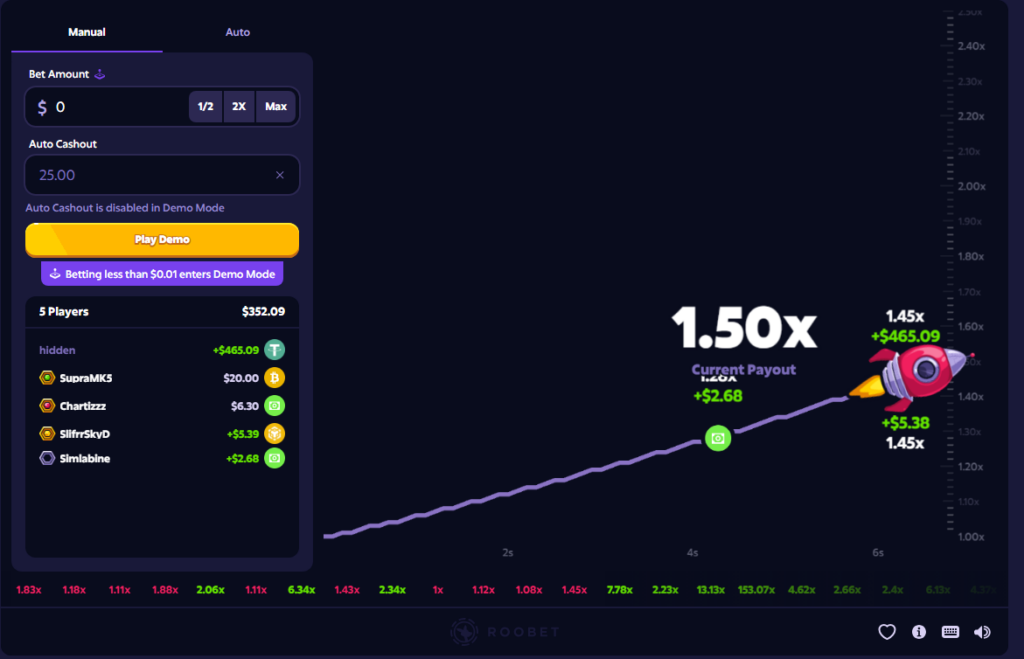
A player must cash out before that point. A successful payout is calculated by multiplying the original wager by the multiplier shown when the cashout is completed.
If a player wagers ten dollars and cashes out at a multiplier of 1.50, the total return is 15 dollars. If the round crashes before the cashout is processed, the entire ten dollar wager is lost.
The Risk Behind Higher Multipliers
The longer a player waits, the larger the displayed potential payout becomes. The probability of reaching that multiplier decreases at the same time.
Cashing out at a low value may produce more frequent successful rounds, but the individual profits are small. Waiting for a very high multiplier creates fewer successful cashouts and larger losing sequences.
Neither approach removes the house edge. They simply produce different patterns of wins and losses.
Manual and Automatic Cashout
Crash may provide both manual and automatic cashout controls.
Manual cashout requires the player to press the button during the round. This makes timing part of the experience, but it also introduces the possibility of hesitation, device lag, or connection delay.
Automatic cashout lets the player choose a target multiplier before the round begins. If the game reaches that value, the wager is collected automatically.
The automatic feature can make execution more consistent, but it cannot guarantee a successful round. The game may crash before reaching the selected target.
Common Crash Misunderstandings
Previous crash points do not reveal what will happen next. A sequence of low multipliers does not mean that a high result is due. Several high results do not make an immediate crash inevitable.
The visible history records earlier rounds. It is not a predictive chart.
Players should also avoid assuming that a low cashout target creates guaranteed profit. A round can crash before almost any selected multiplier, including relatively conservative targets.
How Roobet Mines Works
Mines uses a grid of concealed tiles. Some tiles are safe, while others contain mines.
Before starting, the player chooses the wager and the number of mines hidden on the board. The goal is to reveal safe tiles and collect the available payout before selecting a mine.
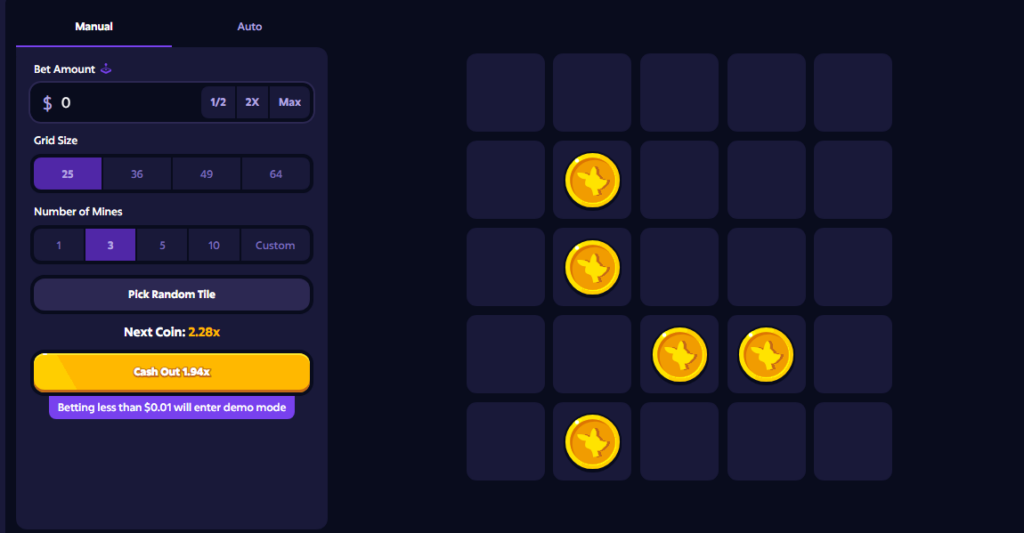
Every successful selection increases the multiplier. The player can normally cash out after revealing at least one safe tile. Selecting a mine ends the round and loses the wager.
Choosing the Number of Mines
The mine setting changes both risk and payout progression.
A board with fewer mines provides a greater chance of selecting a safe tile. Multipliers increase more slowly because the probability of success is higher.
Adding more mines makes each selection riskier. The multiplier rises faster, but the chance of ending the round also increases.
|
Mines setting |
Chance of finding safe tiles |
Multiplier growth |
Typical risk |
|
Fewer mines |
Higher |
Slower |
Lower |
|
Moderate number |
Balanced |
Moderate |
Medium |
|
More mines |
Lower |
Faster |
Higher |
The exact probabilities depend on the number of tiles, mines, and previous safe selections. Players should check the current game rules because available settings can change.
Why Each Selection Becomes More Important
When a safe tile is revealed, the number of remaining safe positions becomes smaller. The value offered for another successful selection increases because the next decision places the accumulated return at risk.
A player can accept the current payout or continue. Continuing may raise the multiplier, but selecting one mine removes the entire potential return from that round.
Do Tile Patterns Matter
The location of mines is not revealed by visual patterns, previous boards, or the order in which tiles were selected.
Choosing corners, moving in a diagonal line, or repeating a favourite arrangement does not create a mathematical advantage when mine positions are generated independently.
A fixed pattern can make selections easier to repeat, but it cannot identify safe tiles in advance.
How Roobet Dice Works
Dice is based on an above or below prediction. The player selects a target and chooses whether the generated result will land above or below it.
Moving the target changes the probability of winning and the available multiplier.
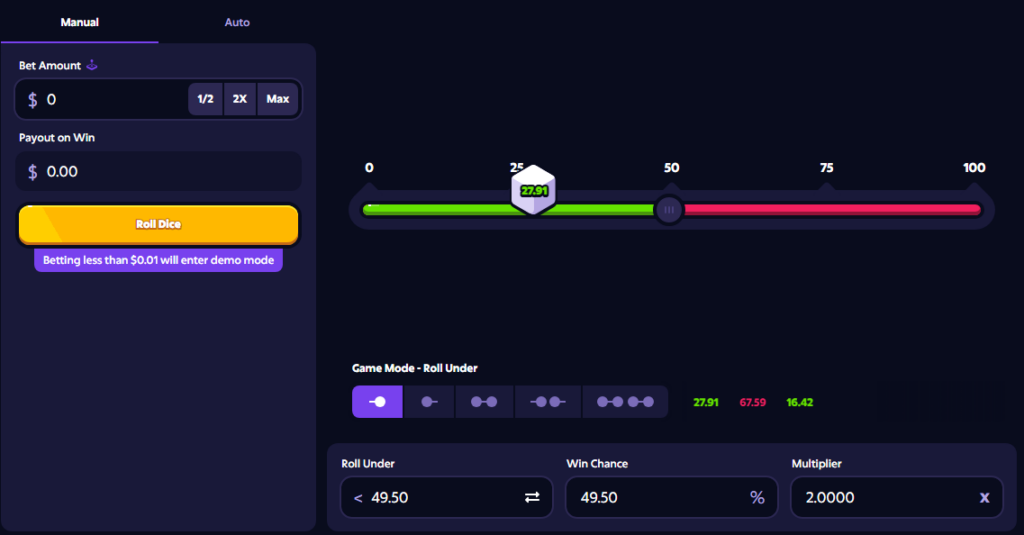
A broad winning range has a higher probability and a smaller payout. A narrow range has a lower probability and a larger potential return.
Adjusting Probability and Payout
Suppose a player chooses a setting with a high chance of success. The corresponding multiplier will remain close to one because the casino is covering many possible winning outcomes.
If the player selects a much less likely range, the multiplier becomes larger. The increased payout compensates for the lower probability, while the built in house edge remains part of the calculation.
This creates a direct relationship between risk and reward.
|
Dice selection |
Winning range |
Potential multiplier |
Volatility |
|
Conservative |
Wide |
Lower |
Lower |
|
Balanced |
Moderate |
Moderate |
Medium |
|
Aggressive |
Narrow |
Higher |
Higher |
Why High Win Chance Does Not Mean Guaranteed Profit
A Dice setting may display a very high probability of winning. That value applies to each individual round and does not prevent losing sequences.
Frequent small wins can be erased by a single loss when the payout is only slightly larger than the original wager. A high successful round percentage is therefore not the same as a positive expected return.
Above and Below Are Equivalent Choices
Selecting above instead of below does not normally provide a special advantage when both options use equivalent probabilities and payouts.
The game does not remember which direction was selected in previous rounds. Alternating between above and below cannot force the results to balance.
How Roobet Towers Works
Towers presents a series of levels. Each level contains safe tiles and at least one losing position.
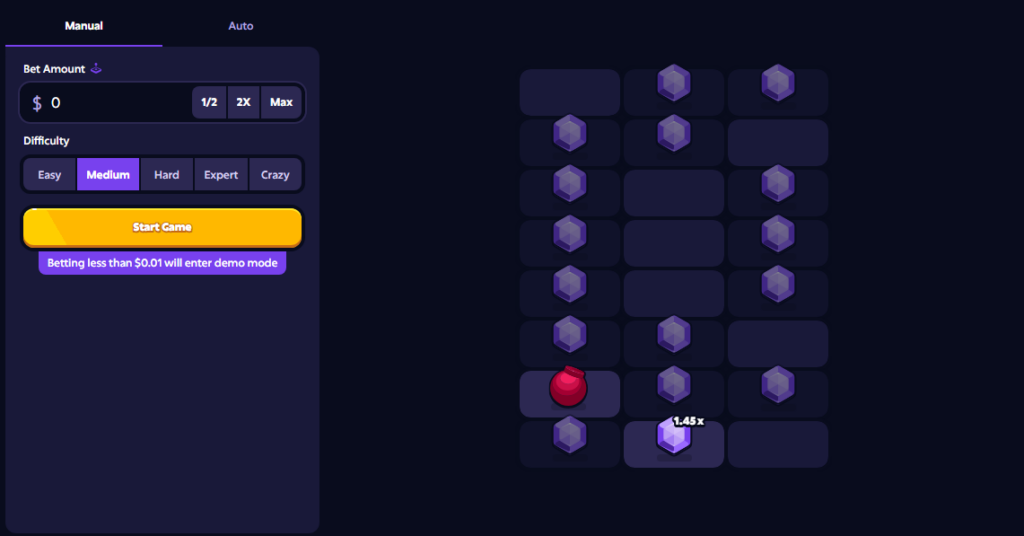
The player selects a tile to move upward. Finding a safe tile unlocks the next level and increases the available multiplier. Selecting a losing tile ends the round.
The player may collect the current payout after a successful choice or continue climbing for a larger multiplier.
Towers Difficulty Levels
Roobet presents several difficulty settings with different numbers of safe and losing tiles.
|
Difficulty |
Losing tiles |
Total tiles on each level |
General risk |
|
Easy |
1 |
5 |
Lower |
|
Medium |
1 |
3 |
Moderate |
|
Hard |
1 |
2 |
High |
|
Expert |
2 |
3 |
Very high |
|
Crazy |
3 |
4 |
Extreme |
Easy mode offers more safe choices on each level, so the multiplier grows gradually. More difficult settings reduce the proportion of safe tiles and increase the available payout more quickly.
The Decision to Continue or Collect
Every successful level creates a new choice. The player can collect the current value or place it at risk by moving higher.
Climbing one additional level may produce a better multiplier, but the current potential payout can be lost immediately. Reaching several safe levels does not improve the probability of the next selection.
The game does not become more generous because a player has already progressed a long way.
Why Favourite Columns Do Not Work
Some players repeatedly select the same column or move across the board in a pattern. These approaches can make the game feel more structured, but they do not reveal the safe position.
A column that was safe during several earlier rounds can contain a losing tile in the next game. The board should be treated as a new random event each time.
Crash vs Mines vs Dice vs Towers
The four games use different interfaces, but their underlying risk structures are closely related.
Crash focuses on time and the decision to collect a rising multiplier. Mines and Towers use concealed safe and losing positions. Dice makes the relationship between probability and payout more visible through an adjustable target.
|
Feature |
Crash |
Mines |
Dice |
Towers |
|
Round pace |
Very fast |
Player controlled |
Very fast |
Player controlled |
|
Main control |
Cashout point |
Mine count and tile selection |
Probability target |
Difficulty and tile selection |
|
Can collect during a round |
Yes |
Yes |
Not usually needed |
Yes |
|
Pattern based prediction |
Not reliable |
Not reliable |
Not reliable |
Not reliable |
|
Risk adjustment |
Cashout target |
Number of mines |
Winning range |
Difficulty level |
Crash and Dice may appeal to players who prefer rapid rounds. Mines and Towers provide more decision points before a round ends.
None of these differences changes the central mathematical principle. A larger possible multiplier always comes with a lower probability of reaching it.
Provably Fair Verification
Many Roobet Originals use a provably fair system. This allows completed results to be checked using cryptographic information associated with the round.
A typical system combines information created by the casino with a value supplied or influenced by the player. The final result can be checked after the round to confirm that the underlying data was not secretly changed after the wager was placed.
Provably fair verification is useful for checking the integrity of a completed result. It does not predict future rounds, remove the house edge, or guarantee a win.
Players should review the verification instructions for the selected game because the process and displayed values may differ between Originals.
Autobet and Automated Progressions
Some Roobet Originals include an Autobet mode. It can repeat selected wagers and may provide controls for the number of rounds, profit limits, loss limits, and changes to the stake after a result.
Automation does not improve the probability of winning. It only increases the speed at which the chosen betting pattern is executed.
A progression that increases the wager after a loss can grow quickly. For example, raising a ten dollar wager by 50 percent after each loss creates the sequence of 10 dollars, 15 dollars, 22.50 dollars, and 33.75 dollars.
The risk comes from the expanding stake rather than from the appearance of the game. Automatic play can generate substantial turnover before the player notices how much the wager has changed.
Payments Are Separate from Game Results
Winning a round and receiving a withdrawal are separate processes. Crash, Mines, Dice, and Towers determine the game result, while the cashier applies identity checks, payment rules, account limits, and any remaining wagering conditions.
A large multiplier does not guarantee an immediate withdrawal. Processing time may depend on account verification, the selected payment method, network congestion, security reviews, and whether the deposit method can receive payouts.
Preparation often matters more than finding a supposed instant payment method. The practical steps covered in tricks to get fast payouts include completing verification early, choosing a compatible withdrawal route, checking bonus conditions, and submitting accurate payment information.
Players should confirm these details before depositing.
- Which documents are required for verification
- Which methods support both deposits and withdrawals
- The minimum and maximum withdrawal amounts
- Possible transaction or network fees
- The casino review period before payment is released
- Whether bonus conditions affect the available balance
- Whether the payment account details match the casino account
Choosing Between the Four Originals
Crash offers the simplest real time decision. The player chooses when to collect while watching a multiplier rise.
Mines offers flexible risk settings and allows several safe selections to be made before cashing out.
Dice provides the clearest view of the relationship between probability and payout because the winning range can be adjusted directly.
Towers turns the same risk decision into a level based format. Every safe choice unlocks a larger multiplier and another opportunity to stop or continue.
The most suitable option depends on the desired pace and type of interaction. Players should compare the rules, house edge, limits, and verification method rather than relying on previous results or visual patterns.